To support our work, please consider giving a donation today.
Thank you for advancing social justice in Massachusetts!
Want to stay informed on the latest issues Massachusetts Appleseed is working on?
Sign up for our mailing list.
To support our work, please consider giving a donation today.
Thank you for advancing social justice in Massachusetts!
Want to stay informed on the latest issues Massachusetts Appleseed is working on?
Sign up for our mailing list.
To support our work, please consider giving a donation today.
Thank you for advancing social justice in Massachusetts!
Want to stay informed on the latest issues Massachusetts Appleseed is working on?
Sign up for our mailing list.
An Act relative to language access and inclusion H.3384/S.2622 (filed by Representatives Madaro and González and Senator DiDomenico), would address this crisis by standardizing and enforcing language access policies and practices at select state agencies to ensure all residents have equal access to the services and information they need.
We have already started a message for you. Click “Start Writing” above to add your own details and urge your legislator to advocate with the Chairs of the Ways and Means Committee to report H.3384/S.2622 out favorably and send it to the floor for a vote.
Language access is essential to the safety, stability, and well-being of our communities. Take this one-minute action to urge your legislator to support this important piece of legislation!
Keep informed & stay involved!
Stay tuned for more opportunities to take action and support Massachusetts families and youth by liking us on Facebook and following us on Instagram and LinkedIn. Check out our website for our most recent news.
To support our work, please consider giving a donation today.
Thank you for advancing social justice in Massachusetts!
Want to stay informed on the latest issues Massachusetts Appleseed is working on?
Sign up for our mailing list.
People depend on state agencies to address needs and challenges – from applying for unemployment assistance, to keeping food on the table and staving off an eviction, to navigating the complexities of the child welfare system. While nearly 1 in 4 Massachusetts residents speak a language other than English in the home, our Commonwealth’s services and information are overwhelmingly conveyed in English alone, effectively denying hundreds of thousands of families the ability to access critical resources.
An Act relative to language access and inclusion H.3384/S.2125 (Sen. DiDomenico, Rep. Madaro, Rep. González), would address this crisis by standardizing and enforcing language access policies and practices at select state agencies to ensure all residents have equal access to the services and information they need.
Language access is essential to the safety, stability, and well-being of our communities. Take this one-minute action to urge your legislator to co-sponsor this important piece of legislation!
Stay tuned for more opportunities to take action and support Massachusetts families and youth by liking us on Facebook and following us Instagram and LinkedIn! Check out our website for our most recent news.
To support our work, please consider giving a donation today.
Thank you for advancing social justice in Massachusetts!
Want to stay informed on the latest issues Massachusetts Appleseed is working on?
Sign up for our mailing list.
In the Massachusetts Department of Children and Families (DCF) where children may be removed from their families, the consequences of language barriers can be profound. Limited English proficient parents are deemed noncompliant and uncaring when, because critical documents and information are only provided in English, they simply do not understand the steps they must take to reunite with their children.
In a complex system already difficult to navigate, this can lead to the wrongful, sometimes permanent separation of families.
This kind of systemic discrimination is just one part of our nation’s extensive history of over-policing and separating families of color and immigrant families. And with newly arrived immigrant families arriving in record numbers, ensuring meaningful language access is more urgent than ever.
The Massachusetts Department of Children and Families is currently accepting comments on two regulations concerning how the agency interacts with families: 110 CMR 5.00 et. seq. and 110 CMR 9.00 et. seq. Take this one-minute action before 5:00 pm this Friday, 8/23 and submit comments urging DCF to include language access in these regulations!
Stay tuned for more opportunities to take action and support Massachusetts families and youth by liking us on Facebook and following us on X (formerly Twitter) and Instagram! Check out our website for our most recent news.
To support our work, please consider giving a donation today.
Thank you for advancing social justice in Massachusetts!
Want to stay informed on the latest issues Massachusetts Appleseed is working on?
Sign up for our mailing list.
The end of the formal legislative session is fast approaching, and we need to make the most of these final weeks!
The legislature is currently considering two major bills: the economic development bill and the housing bond bill. Key amendments to these bills filed by our legislative champions in the State House have given us the opportunity to get some of our policy priorities all the way to the Governor’s desk.
Legislators will be debating the hundreds of amendments for both bills before the end of the week, which means they need to hear from you now! Please join us in taking action below to support Massachusetts youth and young adults.
School rules regarding grooming and dress continue to disproportionately target girls of color and LGBTQ+ students for punishment, reinforcing racist, sexist, homophobic, and transphobic norms in classrooms and pushing students with these identities out of school more frequently.
The effects of punitive school discipline are serious and follow young people into adulthood – students who are suspended or expelled become more likely to drop out of school, struggle to find employment, and earn lower wages overall compared to their peers who graduate.
Rep. Fluker Oakley has filed an amendment to the economic development bill that acknowledges the way unfair school discipline contributes to long-standing educational and economic disparities by funneling already marginalized youth out of school and towards the criminal legal system. Amendment #184 would make rules related to student grooming and dress unbiased and objective as well as stop the suspension or expulsion of students for the perceived violation of these rules, an important component to keep girls of color and LGBTQ+ students in class and out of the school-to-prison pipeline.
Massachusetts students deserve welcoming, inclusive schools where they can show up as their authentic selves and thrive. Please take this one-minute action to contact your State Representative and urge them to co-sponsor and actively support Amendment #184 in the economic development bond bill!
Minors may be experiencing homelessness alone for a number of reasons, such as abuse or family conflict over sexual orientation and gender identity. And while there are existing services that could help, current law prevents youth under the age of 18 from consenting to many of these services without a parent – despite the reality that seeking their parents’ consent is often not an option.
When young people cannot access the services they need, they are extremely vulnerable to victimization and violence. As the 2022 Massachusetts Youth Count found, respondents who left home as minors were less likely to be sheltered, have a high school degree, or receive the help they need.
Amendment #209, filed by Sen. Gomez, would ensure mature minors can access important services, helping youth between the ages of 15 to 18 meet their immediate needs and assisting them on their journey towards stability. Similarly, Sen. Kennedy’s Amendment #271 would support youth and young adults experiencing homelessness by allocating $10,000,000 in funding for housing and wraparound support services, an essential investment that reflects the scale of need across the state.
Massachusetts has seen a surge in youth homelessness over the past year and with queer and BIPOC youth disproportionately impacted, these amendments are critical to establishing increased supports for some of our state’s most marginalized young people. Please take this one-minute action and urge your State Senator to co-sponsor and actively support Amendments #209 and #271 in the housing bond bill!
Stay tuned for more opportunities to take action and support Massachusetts families and youth by liking us on Facebook and following us on X (formerly Twitter) and Instagram! Check out our website for our most recent news.
To support our work, please consider giving a donation today.
Thank you for advancing social justice in Massachusetts!
Want to stay informed on the latest issues Massachusetts Appleseed is working on?
Sign up for our mailing list.
We celebrated a major victory in 2022 when the CROWN Act was signed into law, establishing civil rights protections against natural hairstyle discrimination to prevent the over-policing and surveillance of Black and brown girls as young as five years old.
But we cannot stop now – just a few months after the passage of the CROWN Act, an eighth-grade student in Malden was punished for wearing a hijab. School rules regarding grooming and dress continue to disproportionately target girls of color and LGBTQ+ students for punishment, reinforcing racist, sexist, homophobic, and transphobic norms in classrooms across the Commonwealth.
H.4400/S.2663 would build on the progress established by the CROWN Act by making rules related to student grooming and dress unbiased and objective. Crucially, it would also stop the suspension or expulsion of students for the perceived violation of these rules, an important component to keep girls of color and LGBTQ+ students in class and out of the school-to-prison pipeline.
Massachusetts students deserve welcoming, inclusive schools where they can show up as their authentic selves and thrive. This bill is now sitting in House and Senate Ways and Means and we need your help to keep it moving to the next stage in the legislative process. Take action today and urge your legislators to advocate with State House leadership, asking them to release H.4400/S.2663 and send it to the floor for a vote!
Stay tuned for more opportunities to take action and support Massachusetts families and youth by liking us on Facebook and following us on X (formerly Twitter) and Instagram! Check out our website for our most recent news.
To support our work, please consider giving a donation today.
Thank you for advancing social justice in Massachusetts!
Want to stay informed on the latest issues Massachusetts Appleseed is working on?
Sign up for our mailing list.
Earlier this month marked Joint Rule 10 Day, the deadline for legislative committees to take action on bills and a pivotal moment as we learn which of our legislative priorities have a chance to get passed this session. Four outcomes are possible for each bill:
Join us as we dive into the results of Joint Rule 10 Day, exploring where some of our priority bills have landed and unpacking what this means for our advocacy over the next few months.
The Access to Counsel Bill was reported out favorably, a major milestone in the fight to ensure low-income residents facing eviction have access to legal resources and assistance! With Governor Healey including a line item to fund Access to Counsel in her proposed FY25 budget, this is an opportunity to push for the line item to be passed alongside the more comprehensive bill.
The Education Committee gave a favorable report to the Young Student Exclusion Ban Act, signaling continued support for this bill to address long-standing inequities and opportunity gaps in education. The early years of school are an essential time when children build their educational foundation and reading skills. Alongside our Chapter 222 School Discipline Coalition partners, we’ve been leading the charge on this initiative to keep Massachusetts’ youngest children in class where they are safe, supported, and available to learn.
The Education Committee also favorably reported out the School Interpreter Bill. Demonstrating the important intersection between language access and educational justice, this legislation would ensure families are provided with competent interpretation at school so limited English proficient parents can fully participate in and make informed decisions about their child’s education.
The Everyone Needs ID Bill received a favorable report from the Joint Committee on Transportation, bringing us another step closer to removing barriers that prevent youth experiencing homelessness from obtaining state ID! With state ID necessary to accomplish a host of everyday tasks and access services, this bill can help break the cycle of poverty and upheaval that too many young people find themselves trapped in.
And in exciting news, two of our first-time bills also received favorable reports!
The following bills received deadline extensions, giving committees more time to consider them before they make their final decisions. It also gives us and our fellow advocates a chance to build more support, answer legislators’ questions, and convince lawmakers to report them favorably.
Our 2022 report, “I Just Want to Learn,” highlighted how a lack of diversity among teaching staff can contribute to students of color feeling disconnected, uncomfortable, and fearful of judgement at school. H.549/S.311 would help increase racial and ethnic diversity among school staff, which research shows can lead to direct improvements in educational outcomes for Black and brown students. The deadline has been extended to Friday, March 15.
Good policy starts with good data, and H.454/S.249 would require the Department of Elementary and Secondary Education (DESE) to publish student-specific education data in a way that can be easily cross-tabulated. Critically, this would enable educators, advocates, parents, students, organizers, and policymakers to better identify disparities and inequitable treatment. The deadline has been extended to Friday, March 15.
The foster care-to-homelessness pipeline is well-established – as much as half of Massachusetts’ youth homelessness population is the result of young people emerging from the child welfare system without support. H.157/S.65 would help disrupt this phenomenon by prohibiting the Massachusetts Department of Children and Families from taking foster children’s Social Security benefits for the state’s General Fund, thereby providing youth with greater financial independence as they age out of the system. The deadline has been extended to Thursday, May 2.
Now for the disappointments. The following bills were “sent to study” – essentially ensuring no further action on them this session, but leaving the door open to refile them in future years.
An Act to Create Access to Justice aimed to fill a gap in existing civil rights law by recognizing that when policies have a discriminatory impact – intended or not – Massachusetts residents must be able to take legal action to enforce their rights. The potential impact of this bill is broad and would affect environmental injustices, lack of language access services, the school-to-prison pipeline, lack of sufficient special education services, inadequate prison conditions for certain populations, and more.
An Act Relative to the Location of School Resource Officers recognized the research showing that police presence has no positive effect on school safety and would have required school resource officers be stationed off school grounds. Read more about this issue on our blog.
We know when we lay out an ambitious legislative agenda that not everything is going to make it across the finish line. Grappling with that disappointment is a big part of this work, especially when we’re fighting for commonsense policy changes that address serious needs in our communities.
For bills sent to study – we regroup with our coalition partners. Do we want to refile the bill? Make any changes? Do our legislative sponsors have any feedback from the State House side? We map out what we can do in the meantime, whether that’s conducting deeper policy research or mobilizing in more communities, so we’re ready to hit the ground running next session.
As for the bills that did make it through: We keep going! Getting past Joint Rule 10 Day is a moment to celebrate but until the legislation is on Governor Healey’s desk, ready to be signed, our work is not done. Join MA Appleseed’s mailing list and follow us on Facebook, X (Twitter), and Instagram to stay updated on opportunities to take action in the coming months!
Want to stay informed on the latest issues Massachusetts Appleseed is working on?
Sign up for our mailing list.
Young people under the age of 18 may be experiencing homelessness alone for a number of reasons, such as abuse or family conflict over sexual orientation and gender identity. And while there are existing services that could help, current law prevents underage youth from consenting to many of these services without a parent – despite the reality that seeking their parents’ consent is often not an option.
We worked with Rep. Kay Khan and Sen. Adam Gomez to draft and file H.192/S.94, legislation that would enable youth between the ages of 15 and 18 to provide consent for themselves and access critical supportive services. And in exciting news, the Joint Committee on Children, Families and Persons with Disabilities held a hearing on this bill on October 16th!
Now, we need to make sure it stays at the top of our legislators’ minds to keep it moving through the legislative process. Take action today and urge your legislators to support H.192/S.94, An Act Allowing Certain Minors to Consent to Shelter and Supportive Services!
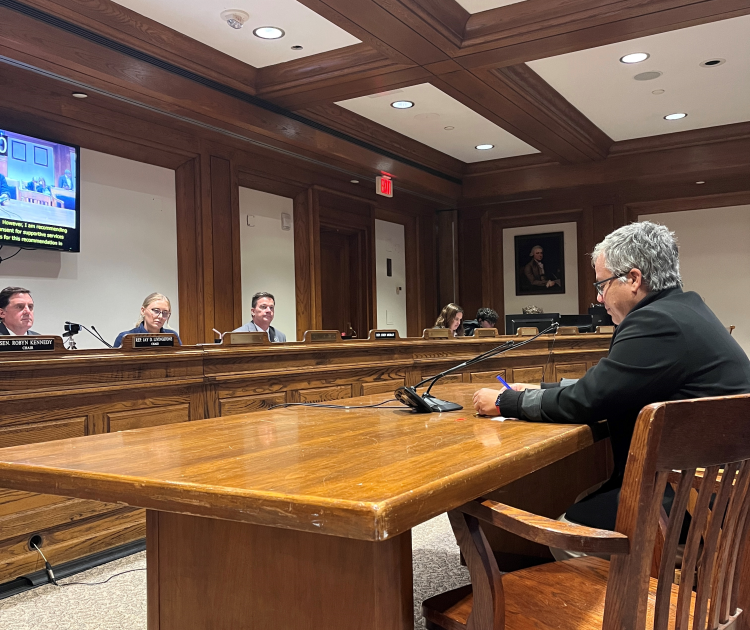
Executive Director Deb Silva testifies before the Joint Committee on Children, Families and Persons with Disabilities.
Underage youth who cannot access the services they need are extremely vulnerable to victimization and violence. As the 2022 Massachusetts Youth Count found, respondents who left home as minors were less likely to be sheltered, have a high school degree, or receive the help they need.
H.192/S.94 would ensure unaccompanied minors between the ages of 15 and 18 years old can meet their immediate survival needs and assist them on their journey towards stability. And with queer and BIPOC youth disproportionately experiencing homelessness, this bill is an important step towards establishing increased supports for some of our state’s most marginalized young people.
We need to keep building support among our lawmakers to ensure the Joint Committee issues a favorable report for this bill! Please take this one-minute action and urge your legislators to make H.192/S.94 one of their priorities this session.
Stay tuned for more opportunities to take action and support Massachusetts families and youth by liking us on Facebook and following us on X (formerly Twitter) and Instagram! Check out our website for our most recent news.
To support our work, please consider giving a donation today.
Thank you for advancing social justice in Massachusetts!
Want to stay informed on the latest issues Massachusetts Appleseed is working on?
Sign up for our mailing list.
It’s budget season, and that means we have important opportunities to fight for necessary funding and overdue policy change.
This year, we’re supporting two key amendments filed by Senator Kennedy:
Amendment #555 would increase funding for housing and supportive services for unaccompanied youth experiencing homelessness (budget line item 4000-0007) from $11 million to $12 million. This increased investment is vital to match the scale of need across the state and help create a sustained and effective response to end youth homelessness.
Amendment #851 would ease the process for unaccompanied youth experiencing homelessness to obtain state identification, an initiative that has previously seen widespread support in the legislature. Again and again, service providers report the difficulty their young clients face in obtaining ID and how this barrier worsens their daily struggles. Young people need state ID to apply for jobs, access public services, open a bank account, and accomplish a host of other important life tasks. It’s long past time to get this common-sense reform signed into law.
It is impossible to overstate the lifetime toll homelessness can take on young people, increasing their risk of poor health outcomes, exposure to violence, susceptibility to exploitation, and dropping out of school. This is especially urgent right now and as young people continue to endure trauma and upheaval in the wake of the COVID-19 pandemic, making sure they have the resources they need to build pathways toward stability and thrive is crucial.
The budget is a reflection of our values, and we cannot let this opportunity to support our state’s most vulnerable youth slip by. Please take action today and urge your State Senator to co-sponsor and support budget amendments #555 and #851.
Stay tuned for more opportunities to take action and support Massachusetts families and youth by liking us on Facebook and following us on Twitter and Instagram! Check out our website for our most recent news.
To support our work, please consider giving a donation today.
Thank you for advancing social justice in Massachusetts!
Want to stay informed on the latest issues Massachusetts Appleseed is working on?
Sign up for our mailing list.